
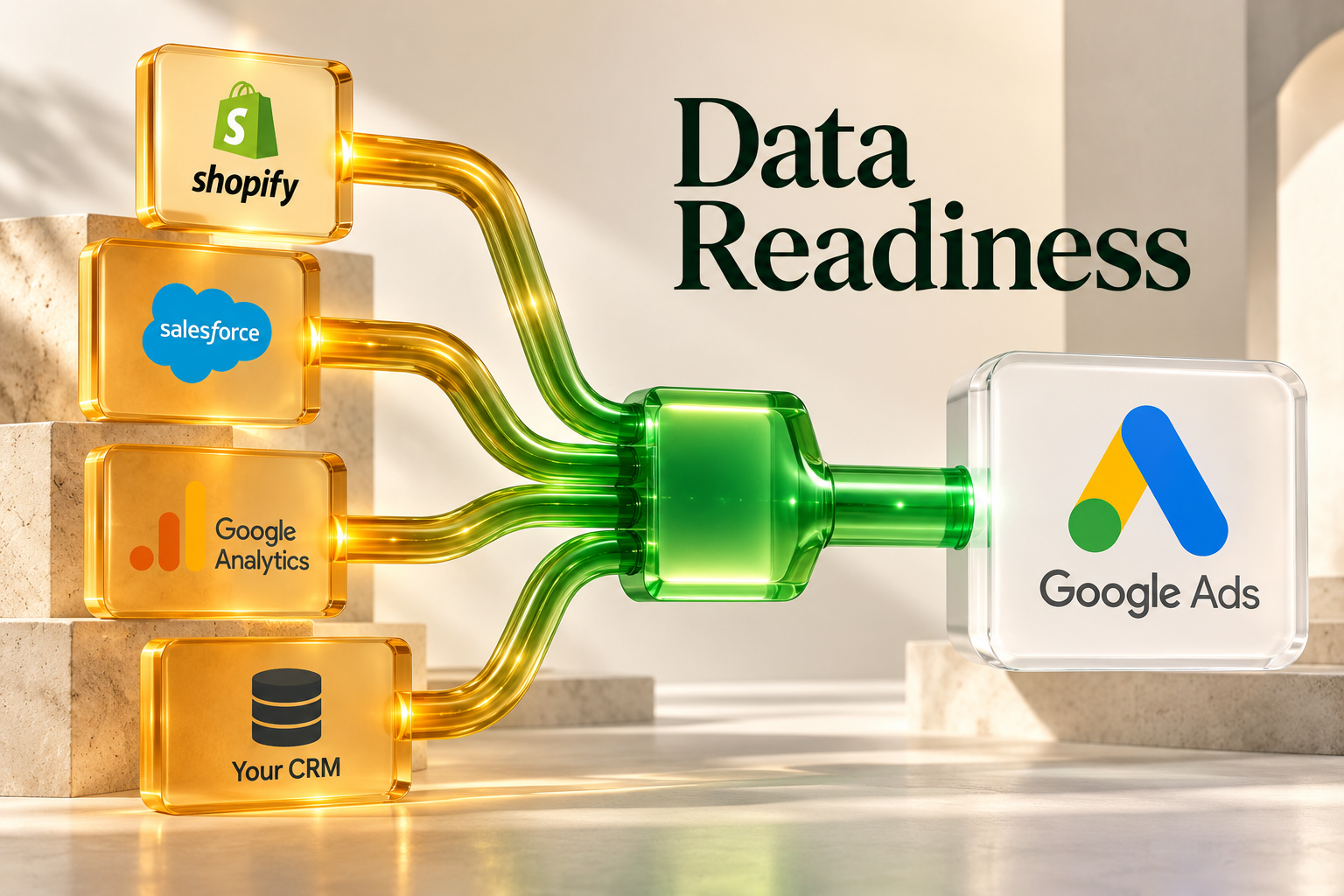
Before acting on Google’s October Demand Gen data announcements, check which features your account actually has and whether the underlying conversion data is dependable. Treat an announced capability, an account rollout and a measured business improvement as three separate facts.
Google’s October Demand Gen announcement was published on 13 October 2026. It discusses Data Strength Uplift, expanded Data Manager connections and forthcoming enhanced-conversion changes. The words used for availability matter: an item described as coming soon should not be documented as a completed rollout to every account.
What the announcement means for an operator
The useful immediate task is an account-readiness review. Confirm the conversion actions your campaigns use, the systems supplying those actions and the person responsible for investigating delivery problems. Do this before increasing budget because a new measurement feature appears.
The Google Accelerate announcement page provides another official reference for the update. When keeping an internal news log, preserve the original announcement date separately from a later listing or publication date on another Google page.
| Announced area | Account check | Evidence to retain |
|---|---|---|
| Data Strength Uplift | Is the feature present and what does the interface describe? | Account date and applicable explanation |
| Data Manager expansion | Is the required supported connection available? | Source, destination and connection status |
| Enhanced conversions | Is the relevant change available or still upcoming? | Current documentation and observed configuration |
| Conversion inputs | Is the intended business action being delivered correctly? | Action definition and diagnostic record |
Do not reuse a vendor’s reported performance percentage as a forecast for your campaign. Even an account-level estimate is different from verified incremental profit.
Trace the business action before adding another connection
Choose the action that matters: a qualified enquiry, completed sale or another defined outcome. Record where it first exists, which system sends it onward and how duplicate deliveries are recognised. A connection being enabled does not prove that the right action, value or timestamp reaches its destination.
For lead generation, distinguish a form submission from a qualified lead. For ecommerce, distinguish an order placed from revenue that is actually retained after cancellations or returns. Use the action appropriate to the campaign’s stated objective and the platform’s supported implementation.
Check permissions and consent with the responsible owner before connecting customer data. Use the platform’s current instructions for required formatting and permitted use. A marketing announcement is not a complete implementation specification.
Build a rollout decision log
Record the account, feature, availability observed, documentation date, current configuration, proposed change, owner and rollback route. If the feature is missing, record that observation instead of creating steps from a screenshot of another advertiser’s account.
Illustrative example: an operator sees a new data-strength-related panel while reviewing a lead campaign. The team discovers that its offline record defines a qualified lead differently from the website’s submission event. The first task is to settle and validate that definition. Connecting another source before doing so could increase the amount of inconsistent data rather than its usefulness.
This example is a decision process, not an observed campaign result or a recommendation to change bidding settings.
Review outcomes with comparable evidence
Annotate the date of a real implementation change. Retain a suitable pre-change period and note changes to spend, creative, audience, offers and conversion definitions. Do not interpret every post-change movement as the new feature’s effect.
Use delivery diagnostics for implementation questions and business reporting for commercial questions. If a metric is modelled, estimated or account-specific, preserve that label when sharing it with a client.
Seolign’s paid-lead CRM tracking guide helps define the downstream action. Use the conversion-goal workflow to separate primary business goals from supporting activity.
Should I increase budget when a new panel appears?
The panel’s presence alone is not a budget decision. First establish what it measures, whether the inputs are correct and how the campaign’s economics support a change.
What if my account does not show the feature?
Check the current official availability information and the account’s supported configuration. Do not assume an announcement guarantees access in every account.
Pingback: Google Ads Remarketing Not Working? 7 Checks to Fix It